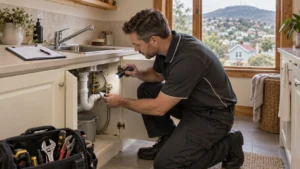
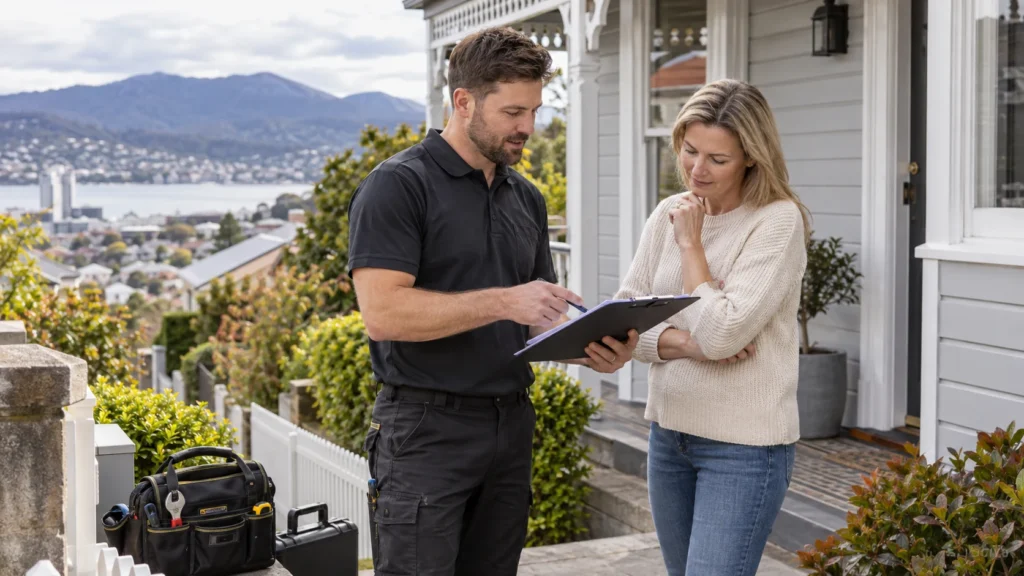
To choose the right plumber in Hobart, run seven checks before any work starts. Look up their licence on the CBOS register, confirm the business holds a contractor licence, ask for proof of at least $5 million in insurance, read recent reviews, match their skills to your job, get an itemised written quote, and ask whether the job needs council approval. A plumber who passes all seven is licensed, insured and accountable for the work.
At Solus Plumbing, our plumbers hold a 4.9-star average across verified Google reviews, and a common reason people call us is to fix a job someone else started. Often the first plumber wasn’t properly licensed, or never put the scope and price in writing. This guide covers the checks we’d run if we were hiring a plumber for our own homes, using Tasmanian rules on licences, insurance, council permits and who pays for sewer repairs.
Hobart plumber checklist at a glance
| Check | What to do | Why it matters |
| 1. Licence | Search the plumber on the CBOS register | Plumbing work in Tasmania must be done by a licensed plumber |
| 2. Contractor licence | Confirm the business you sign with holds one | Anyone contracting to do plumbing work in Tasmania needs a contractor licence |
| 3. Insurance | Ask for a Certificate of Currency | Plumbing contractors must hold at least $5 million cover per incident |
| 4. Reviews | Read recent Google reviews for detail and patterns | Shows reliability, communication and follow-up |
| 5. Right skills | Ask about drain cameras, leak detection and gas-fitting | Specialist jobs need specialist gear and licences |
| 6. Written quote | Get an itemised price for the same scope from each plumber | Lets you compare fairly and avoid surprise extras |
| 7. Council approval | Ask which permit category your job falls into | Category 3 and 4 work needs council paperwork before it starts |
How do you check a plumber’s licence in Tasmania?
You can check a plumber’s licence for free using the CBOS search to find a licensed tradesperson. CBOS (Consumer, Building and Occupational Services) is the Tasmanian regulator for plumbers, gas-fitters, electricians and builders. Search by name or licence number, and confirm the licence is current before you let anyone start.
Don’t rely on a logo on a van or a number on a business card. Ask for the licence number, search it yourself, and check that the name matches the person or business on your quote.
What are the different plumbing licences in Tasmania?
Tasmania issues three types of plumbing licences. Each one allows a different level of work.
| Licence type | Who holds it | What it means for you |
| Practitioner licence | An individual qualified plumber | Allowed to carry out plumbing work |
| Contractor licence | The business or sole trader you sign with | Allowed to enter a contract with you to do plumbing work |
| Provisional licence | A plumber still working toward full licensing, such as an apprentice | Should be supervised by a fully licensed plumber |
According to Service Tasmania’s guide to the plumbing contractor licence, “you must have a plumbing contractor’s licence if you are entering into a contract to perform plumbing work in Tasmania.” So if you’re paying a plumbing business, that business needs a contractor licence, and the person doing the work needs a practitioner licence.
Licensed plumbers in Tasmania must also complete continuing professional development (CPD) to keep their licence. That means a currently licensed plumber has kept up with changes to standards and safety rules.
Does the plumber need a gas-fitting licence?
Yes, if your job involves gas. Tasmania treats gas-fitting licences as a separate licence from plumbing. A plumber who is licensed for water and drainage can’t legally connect or service a gas hot water unit, cooktop or heater unless they also hold a gas-fitting licence.
Many Hobart homes use gas for hot water or heating. If your job involves gas fitting, search the plumber’s gas-fitting licence on the CBOS register as well.
Can a mainland plumber work in Hobart?
Yes. Under Automatic Mutual Recognition, a plumber licensed in another state can work in Tasmania after notifying the Tasmanian Government. They can only do the same type of work they’re licensed for at home, and they must follow Tasmanian rules, including CPD and the local code of conduct. If they’re contracting with you, they need at least $5 million in public and products liability insurance.
What insurance should a Hobart plumber have?
A plumbing contractor in Tasmania must hold insurance of at least $5 million for any one incident. This is a condition of the contractor licence, so an uninsured contractor shouldn’t be trading at all.
Ask for the Certificate of Currency before work starts. Check three things:
- The name on the certificate matches the business on your quote
- The policy dates are current
- The cover is at least $5 million for public liability
Some plumbers also carry professional indemnity or product liability cover. It isn’t always required, but it’s a good sign of a well-run business.
What warranty should you expect from a plumber?
On top of insurance, a good plumber gives you a written warranty on workmanship and parts. Terms vary, so get them in writing before you agree to the job. Our approach at Solus Plumbing is a 12-month warranty on repairs and up to five years on the workmanship of new installations, with free return visits if covered work fails.
How do you check a plumber’s reviews and reputation?
Read recent Google reviews and focus on the details in the written comments. A plumber with steady reviews over several years, from customers describing specific jobs, is usually a safer choice than one with a handful of perfect scores. Local Facebook community groups and recommendations from neighbours are also useful in a city Hobart’s size.
The ACCC’s guide to spotting fake reviews lists warning signs:
- A spike in very positive or very negative reviews over a short period
- Reviewers with similar names
- Reviews written in similar language
- Generic reviews with no specific detail about the job
When we read reviews for trades ourselves, we look for mentions of arriving on time, explaining the problem clearly, a final bill that matched the quote, and how callbacks were handled.
Should you choose a Master Plumbers member?
Membership of the Master Plumbers Association of Tasmania is a good sign. Members agree to the association’s code of conduct, which requires “the highest standard of honesty in all transactions” and ongoing skill development. It’s still worth checking the licence on the CBOS register yourself, because membership isn’t a substitute for a current licence.
Does the plumber have the right skills for your job?
Blocked sewers, hidden leaks and gas appliances each need different equipment and, sometimes, a different licence. Ask each plumber how often they do your type of job and what they’ll bring.
| Your problem | What to ask the plumber | What a good answer sounds like |
| Recurring blocked drain | Do you do CCTV drain camera inspections? | Yes, and we’ll show you the footage before quoting a repair |
| Hidden or slab leak | What leak detection equipment do you use? | Acoustic listening, thermal imaging or tracer gas |
| Cracked or root-damaged sewer | Do you offer pipe relining? | Yes, after a camera survey confirms the damage |
| Gas hot water or heater | Do you hold a Tasmanian gas-fitting licence? | Yes, and here’s the number to check |
| Burst pipe or sewage overflow | Do you offer 24/7 emergency service? | Yes, with after-hours rates quoted upfront |
Choosing a plumber for blocked drains and sewer problems
For blocked drains that keep coming back, choose a plumber who uses a CCTV drain camera. A camera shows tree-root intrusion, cracked joints or a collapsed section before anyone starts digging. Without it, you can end up paying to clear the same blockage several times.
If the camera finds damage, pipe relining can often repair the pipe from the inside without trenching the yard. That matters on Hobart’s steep blocks, where digging is slow and expensive.
Choosing a plumber for hot water, leaks and emergencies
For hot water systems, confirm the plumber can handle the whole install, including any gas connection. Hobart winters put heavy demand on hot water, so ask the plumber how they sized the unit for your household, not just what it costs.
For burst and leaking pipes behind walls or under floors, ask about leak detection gear. Plumbers who use it can usually find the leak without opening large sections of wall. For emergencies, check that the plumber will actually attend overnight, and ask for the after-hours call-out fee and hourly rate before you book.
How much do plumbers charge in Hobart?
Most Hobart plumbers charge between $80 and $200 an hour for standard labour, plus a call-out fee of about $60 to $250. After-hours work usually costs 1.5 to 2 times the daytime rate. Properties in outer areas like the Huon Valley, Sorell or the Derwent Valley may attract a higher call-out fee or travel charge.
| Job | Typical Hobart price |
| Fix a leaking tap or toilet (labour) | $80 to $150 |
| Replace a shower or bath tap (labour) | $80 to $350 |
| Install a toilet or basin (labour) | $250 to $600 |
| Replace a hot water system (unit and install) | $1,200 to $2,500 or more |
| After-hours call-out fee | About $150 to $350 |
Use these ranges to sense-check your quotes. A price far above them should come with a clear reason, like difficult access or council paperwork. A price far below them is worth questioning too. If you’d like to compare mainland rates, our Melbourne plumber cost guide lists typical prices for the same jobs.
You can save on call-out fees by bundling small jobs into one visit. A dripping tap, a running cistern and a loose mixer can usually be fixed together. Our page on taps, toilets and fixtures covers the common repairs.
Why do some Hobart plumbers charge more for council jobs?
Some Hobart plumbers add a “pain tax” to jobs that need council approval. An ABC News investigation found some plumbers charge up to 30% extra on work in the Hobart City Council area to cover approval delays. A councillor’s survey of plumbers found some were adding $2,000 to $4,000 per job. The council said “the vast majority of applications are handled efficiently and without issue” and that a new plumbing inspector would lift its capacity by 25%.
This mainly affects larger jobs that need council approval. A tap repair or blocked drain clear usually needs no council involvement. If two quotes for a larger job differ by thousands, ask each plumber whether they’ve allowed for council delays.
How many quotes should you get, and what should they include?
Get two or three written quotes for any job worth more than a few hundred dollars. For a small repair, one clear fixed price from a licensed plumber is usually enough.
A good quote is itemised and lists:
- The plumber’s licence number, and the contractor licence number of the business
- The call-out or diagnostic fee, and whether it’s credited if you go ahead
- Labour, as a fixed price or hourly rate
- Parts and materials, listed separately
- Council permit, notification and inspection costs, if needed
- After-hours surcharges
- GST and payment terms
- Warranty terms
Make sure each plumber is quoting the same scope. Two quotes that look far apart are often quoting different jobs. One might just clear a drain, while another clears it, films the line and reports on the cause.
Fixed price or hourly rate?
| Pricing model | Best for | Watch out for |
| Fixed price | Defined jobs like a hot water swap, drain clear or tap replacement | Check exactly what’s included so extras aren’t added later |
| Hourly rate | Diagnostic or open-ended work like leak tracing | Ask for an estimate or cap, and whether travel time is billed |
At Solus Plumbing, we give a fixed written quote on site before any work starts, and the diagnostic fee comes off the repair cost if you go ahead. We’ve found fixed pricing avoids the most common dispute, where a job runs longer than expected and the bill grows.
Do you need a written contract for plumbing work in Tasmania?
Most plumbing repairs cost far less than $20,000, so a written quote and invoice are usually enough. If plumbing is part of a larger residential building job of $20,000 or more, the CBOS residential building consumer guide says the contract must be in writing, dated and signed by both parties. Deposits are capped at 10% for contracts between $20,000 and $50,000, and 5% for contracts of $50,000 or more.
For smaller repairs, you shouldn’t need to pay a large deposit. Pay the balance once the work is finished and you’re satisfied with it.
Does your plumbing job need a council permit in Hobart?
Many everyday repairs in Tasmania need no permit, but larger jobs do. Tasmania sorts plumbing work into risk categories, and the category decides what paperwork applies.
| Category | Who can do it | Approval needed |
| Category 1 (low risk) | Property owner | None |
| Category 2A (low risk) | Licensed plumber | None |
| Category 2B (low risk) | Licensed plumber | Notify council after completion |
| Category 3 (medium risk) | Licensed plumber | Notice of Work and Certificate of Likely Compliance before starting |
| Category 4 (high risk) | Licensed plumber | Plumbing permit and Certificate of Likely Compliance before starting |
Source: Glenorchy City Council permit guide.
Category 3 and 4 work involves staged inspections, and the plumber can’t move past each stage without approval. A good plumber will tell you the category upfront and include the paperwork in the quote. If a plumber suggests skipping notification on a job that clearly needs it, treat that as a red flag. Unapproved work can cause problems when you sell or make an insurance claim.
What should you know about plumbing in Hobart homes?
Hobart’s housing ranges from Georgian and Victorian cottages to post-war weatherboards and new buildings in the northern suburbs and on the Eastern Shore. That mix affects which plumber suits your property.
Choosing a plumber for an older Hobart home
Heritage homes in Battery Point, North Hobart, West Hobart and Sandy Bay often have older clay or cast-iron drains. Clay pipes crack and let tree roots in at the joints, and cast iron corrodes over time. Choose a plumber who works on older pipework regularly and uses a drain camera. They’re more likely to spot early warning signs and suggest trenchless repairs where they suit.
Hobart’s hilly streets also make access harder than in flatter cities. Tight subfloors and steep driveways add time, so a plumber who knows local properties will usually quote more accurately.
Who pays for sewer repairs in Hobart?
The homeowner pays for repairs to private pipes on their side of the connection point. According to TasWater, it maintains pipes from the main to the customer’s connection point. For sewerage, the pipe from the connection point to the house, usually at the inspection opening, is the owner’s responsibility.
For a sewer blockage, call a plumber first. If they find the fault is in TasWater’s infrastructure, contact TasWater on 13 6992. Plumbers can’t work on TasWater pipes without permission, so a camera inspection before any repair can save you paying for a pipe that isn’t yours.
What are the red flags when hiring a plumber in Hobart?
Walk away, or at least slow down, if you notice any of these:
- No licence number, or one that doesn’t match the name on the quote
- No contractor licence for the business you’re signing with
- No gas-fitting licence for gas work
- No Certificate of Currency for insurance
- Cash-only payment with no written quote or invoice
- A quote far below every other quote, with no clear explanation
- Pressure to decide on the spot
- Suggestions to skip council notification or permits
- Reviews that all appeared in the same few weeks
In our experience, the cheapest quote on paper often becomes the most expensive job. The gap usually shows up later as the wrong parts, missing paperwork or a repeat callout.
Frequently asked questions
Can I do my own plumbing in Tasmania?
Only Category 1 work, which is low-risk plumbing a property owner is allowed to do without approval. Anything in Category 2, 3 or 4 must be done by a licensed plumber.
Is a provisional plumbing licence enough for a Hobart job?
Not on its own. A provisional licence holder is still working toward full licensing and should be supervised by a fully licensed plumber. The business you contract with should also hold a contractor licence.
How do I know if an emergency plumber in Hobart is legitimate?
Ask for their licence number over the phone and check it on the CBOS register before they arrive. A legitimate emergency plumber will also quote the after-hours call-out fee and hourly rate before attending.
Should I pay a plumber a deposit in Hobart?
For most repairs, you shouldn’t need to pay upfront. If plumbing is part of a residential building contract of $20,000 or more, Tasmanian rules cap deposits at 10% for contracts up to $50,000 and 5% above that.
What can I do if I’m unhappy with a plumber’s work in Tasmania?
Contact the plumber first and give them a chance to fix it under warranty. If that doesn’t work, CBOS can provide information and, in some cases, help to resolve a dispute. You can call CBOS on 1300 654 499.
Find a licensed plumber in Hobart
The right plumber in Hobart holds a current CBOS licence, works through a licensed contractor with at least $5 million in insurance, has genuine reviews and the right equipment, and puts the price and any council paperwork in writing. Run those seven checks on every plumber you shortlist, and you’ll avoid most of the problems we’re called in to fix.
Solus Plumbing doesn’t currently service Tasmania, so use this checklist to find a good local plumber in Hobart. If you’re in Sydney, Melbourne, Brisbane, Perth, Adelaide or Canberra, our plumbers offer same-day service on most jobs, a fixed price before we start, and a 12-month warranty on repairs. For more detail on Victorian rules, see our guide to choosing a plumber in Melbourne. Call Solus Plumbing on 1300 730 896 or request a quote.