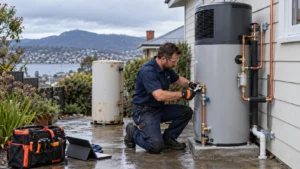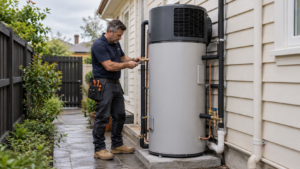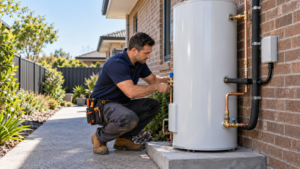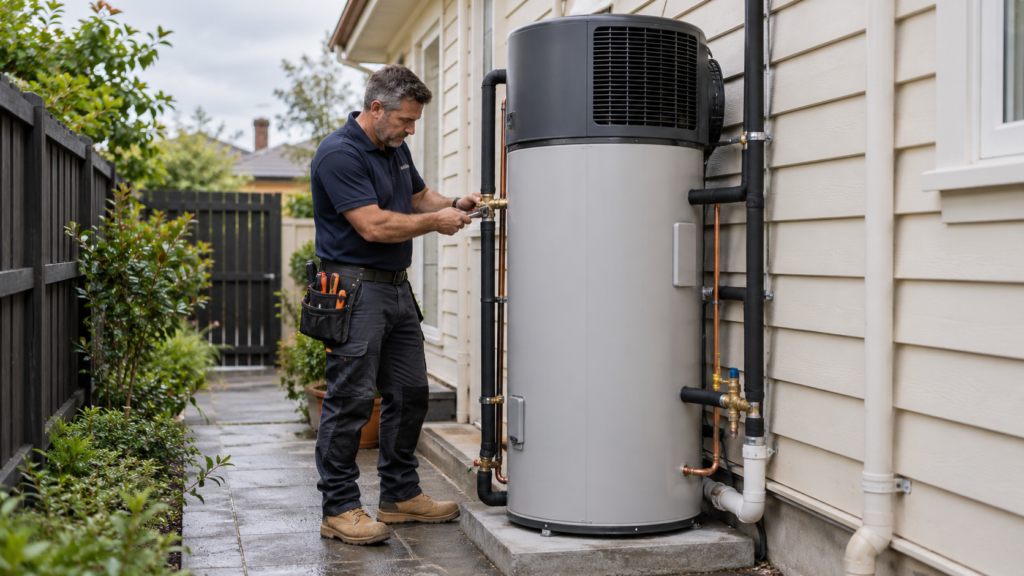
Replacing a hot water system in Melbourne costs about $840 to $7,350 installed in 2026, depending on the type of system. A like-for-like electric storage tank swap typically lands around $1,900. A gas storage or gas continuous flow unit typically costs about $2,300 installed. A heat pump runs $3,150 to $6,300 before rebates, and solar hot water sits at the top at $3,675 to $7,350.
Those figures cover the unit and the labour. Victorian rebates change the picture more than in any other state. The Solar Victoria hot water rebate and a Victorian Energy Upgrades discount can take up to $1,630 off an efficient system, or up to $2,030 for an Australian-made unit, which brings a typical heat pump down to about $3,200 out of pocket. At Solus Plumbing, our Melbourne team replaces hot water systems across the city every week, and every new installation comes with a 5-year workmanship warranty. In our experience, the two things that catch Melbourne homeowners out are the compliance items added to a quote, and the rule that from 1 March 2027 a failed gas system in an existing home must be replaced with electricity.
This guide covers 2026 Melbourne prices by system type, the extra fees on a quote, the Victorian rebates, the new gas rules, and how to size a system without overspending.
Hot water system replacement prices in Melbourne at a glance
| System type | Installed cost in Melbourne (2026) | Typical quote | Approximate running cost per year |
| Electric storage tank | $840 to $3,150 | $1,900 | $525 to $1,250 |
| Gas storage tank | $1,250 to $3,675 | $2,300 | Lower than electric, depends on tariff |
| Gas continuous flow | $1,575 to $3,675 | $2,300 | Lower than electric, depends on tariff |
| Heat pump (before rebates) | $3,150 to $6,300 | $4,400 | About $200 to $350 |
| Heat pump (after rebates) | $2,225 to $4,725 | $3,200 | About $200 to $350 |
| Solar hot water | $3,675 to $7,350 | $5,250 | Minimal, plus booster use |
These ranges come from an independent Melbourne hot water cost guide verified in October 2026 and include supply and installation with GST. They do not include rebates. The low end of each range is a small or basic unit in an easy location. The high end is a large or premium unit, a relocation, or a changeover from one fuel type to another.
How much does it cost to replace an electric hot water system in Melbourne?
Replacing an electric storage hot water system in Melbourne costs about $840 to $3,150 installed, with a typical quote around $1,900. A simple swap of a 160 to 250 litre tank in the same spot, reusing the existing wiring and pipework, sits at the lower end. Large 315 litre tanks and jobs that need the unit moved sit at the top.
Electric storage is the cheapest system to buy and install because it needs no gas fitting and no roof work. The trade-off is the running cost. A standard electric tank in Melbourne costs about $525 to $1,250 a year to run, with $840 being typical, which is the highest of any system type. Off-peak tariffs bring that down, which is why most Melbourne homes with electric storage run a 250 litre or larger tank that heats overnight.
If your existing system is electric, this is the point to compare a heat pump. The upfront price is higher, but the Victorian Energy Upgrades discount is largest for an electric-to-heat-pump swap, and the running cost drops to roughly a quarter of what you pay now.
How much does a gas hot water system cost to replace in Melbourne?
A gas storage hot water system costs about $1,250 to $3,675 installed in Melbourne, with a typical quote of $2,300. Gas continuous flow (also called instantaneous or tankless) costs about $1,575 to $3,675 installed, also typically around $2,300.
Gas is still the most common system we replace in Melbourne, because so many homes here were built with a gas connection. Gas costs more to install than electric for three reasons:
- A gasfitting licence is required. In Victoria, gas work needs the gasfitting class of plumbing registration or licence, which is separate from water supply work.
- Gas line work. Swapping a storage tank for a continuous flow unit often needs a larger gas supply line, because continuous flow units draw more gas on demand.
- A compliance certificate is mandatory. The Building and Plumbing Commission (BPC) requires a certificate for installing or replacing any Type A gas appliance, including a gas hot water unit, regardless of what the job costs.
Our gas fitting team handles the gas connection, pressure test and compliance certificate as part of the installation, so it does not show up as a separate trade on the quote.
Can you still replace a gas hot water system in Victoria?
Yes, until 1 March 2027. From that date, under Victoria’s gas reforms, a gas hot water system in an existing home that reaches the end of its life must be replaced with an electric system such as a heat pump. The Victorian Government expects the switch to save households around $330 a year, or $520 with rooftop solar.
A few details matter here:
- Gas systems can still be repaired after 1 March 2027. The rule applies when the unit is beyond repair.
- Rental properties face the same requirement under the new minimum energy efficiency standards, with exemptions where installation cost is too high or there is not enough space.
- Replacing gas with gas before the deadline is legal, but you are buying a system that will be the last gas unit in that home.
In our view, if your gas tank is 10 years or older and you are planning ahead, the 2026 rebates make a heat pump the better long-term choice in most Melbourne homes. If your gas unit has failed in winter and you need hot water tonight, a like-for-like gas swap is still a sensible option this year.
How much does a heat pump hot water system cost in Melbourne?
A heat pump hot water system costs about $3,150 to $6,300 installed in Melbourne before rebates, with a typical quote around $4,400. After the Solar Victoria rebate and a Victorian Energy Upgrades discount, the typical out-of-pocket cost drops to about $3,200, with a range of $2,225 to $4,725.
Heat pumps are electric systems that pull heat from the surrounding air rather than heating water with an element. The Victorian Government notes they use up to 75% less electricity than a standard electric storage tank, which is why running costs sit around $200 to $350 a year. Common brands include Rheem AmbiHeat, Sanden, iStore and Reclaim Energy.
Size affects the price:
- 250 to 270 litre heat pump for 1 to 3 people: $3,150 to $6,300 installed, typically $4,000
- 300 to 315 litre heat pump for 3 to 5 people: $3,575 to $7,350 installed, typically $4,725
Melbourne winters affect heat pump performance. Heat pumps still work in the cold, but they run longer and some models switch to a backup element below a certain temperature, so ask for the unit’s rated operating range and confirm it covers Melbourne’s winter lows. The compressor makes some noise and needs clear airflow, so the unit cannot always go where the old tank sat, and relocation adds pipework and labour. Some models also need a dedicated electrical circuit, which means an electrician on site as well as a plumber.
How much does solar hot water cost in Melbourne?
Solar hot water costs about $3,675 to $7,350 installed in Melbourne, with a typical quote around $5,250. That is before rebates, which can cut up to $1,630 off the price through the same Solar Victoria and Victorian Energy Upgrades programs.
Solar systems are usually sized at 250 to 400 litres with an electric or gas booster for cloudy days. They have the highest upfront cost of any system but the lowest running cost, since the sun does most of the heating from spring to autumn. Melbourne’s overcast winters mean the booster runs more than it would in Brisbane or Perth, so running costs are higher here than national brochures suggest.
Installation cost depends on roof access and whether the tank sits on the roof (close-coupled) or on the ground (split system). Two-storey homes, tiled roofs and south-facing roofs take longer and may need evacuated tube collectors, which cost more than flat plates.
What extra fees get added to a hot water replacement quote in Melbourne?
Most Melbourne hot water quotes include a few items beyond the unit and the basic labour. The common ones are:
| Extra item | Typical Melbourne cost | When it applies |
| Tempering valve | $160 to $420, typically $260 | Where the old system did not have one |
| Old unit removal and disposal | $79 to $210, typically $135 | Almost every replacement |
| Pressure limiting valve | Quoted per job | Where mains pressure is too high for the new tank |
| Relief drain line | Quoted per job | Where the old install had no compliant drain line |
| Electrical work | Quoted per job | Heat pumps on a new circuit, or rewiring old electric tanks |
| Gas line upgrade | Quoted per job | Storage-to-continuous-flow conversions |
| Compliance certificate | Included in a proper quote | All gas work, and any job over $750 |
The tempering valve catches most people out. Victorian plumbing laws require a maximum of 50 degrees Celsius at every shower head and bathroom tap to prevent scalding, while the tank must store water above 60 degrees to stop Legionella bacteria growing. A tempering valve is what makes both possible. The BPC notes that systems installed before 5 August 1998 are unlikely to be tempered, which describes a lot of the tanks we pull out of homes in Brunswick, Preston and Footscray.
Labour is the other variable. Melbourne plumbers charge about $80 to $160 an hour, with call-out fees of $60 to $160, as covered in our Melbourne plumber cost guide. A like-for-like swap takes 2 to 4 hours. Moving the unit, running a new gas line or working on a roof can take most of a day.
When we quote a replacement at Solus Plumbing, we list these items separately so you can see what is the unit, what is labour and what is compliance work. If any quote is a single lump sum, ask for it to be broken down. Two quotes that look $400 apart are often quoting different jobs.
What hot water rebates are available in Melbourne in 2026?
Melbourne homeowners can claim up to three incentives on an efficient hot water replacement in 2026: the Solar Victoria hot water rebate, a Victorian Energy Upgrades (VEU) discount, and federal Small-scale Technology Certificates (STCs). Solar Victoria says the first two combined can reduce the upfront cost by up to $1,630, or up to $2,030 for an eligible Australian-made system.
Solar Victoria hot water rebate
The Solar Homes hot water rebate covers 50% of the purchase price of an eligible heat pump or solar hot water system, capped at $1,000. Since 1 July 2025, the cap rises to $1,400 for an approved Australian-made product. To qualify in 2026:
- You must be the owner-occupier of an existing home
- Combined household taxable income of all owners must be under $150,000 a year
- The property must be valued under $3 million
- The system being replaced must be at least 3 years old
- The property must not have already received a hot water or solar battery rebate under the Solar Homes Program
- The installer must be an authorised hot water retailer using an eligible product
Victorian Energy Upgrades discount
The VEU program is delivered by accredited providers who apply the discount on your quote and handle the paperwork. The Victorian Government lists these indicative discounts for 2026:
| Replacing | With | Indicative VEU discount |
| Electric storage | Heat pump | $630 |
| Electric storage | Solar-boosted hot water | $910 |
| Gas storage | Heat pump | $560 |
| Gas storage | Solar-boosted hot water | $700 |
The existing system must be at least 2 years old, the new unit needs a minimum 5-year warranty, and you must contribute at least $200 yourself. Private rentals are eligible, so landlords preparing for the 2027 standards can use it.
Federal STCs
STCs apply to heat pumps and solar hot water under the federal Small-scale Renewable Energy Scheme. The number of certificates depends on the system and your climate zone, and Melbourne sits in Zone 4. The installer usually claims the certificates and shows the value as a discount on the invoice, typically worth several hundred dollars on a 270 to 315 litre heat pump. Solar Victoria calculates its rebate after STCs and VEU discounts have been applied, so the order of discounts on the quote matters.
What that means for your quote
| Replacement scenario | Before rebates | Typical rebates | Typical cost after rebates |
| Electric tank to heat pump | $4,400 | Up to $1,630 combined | About $3,200 |
| Gas tank to heat pump | $4,400 | Up to $1,560 combined | About $3,300 |
| Electric or gas to solar | $5,250 | Up to $1,630 combined | About $3,600 to $4,000 |
STC values fall each year as the scheme winds down towards 2030, so a heat pump installed in 2026 attracts a slightly bigger discount than the same unit installed in 2027.
Is it cheaper to repair or replace a hot water system in Melbourne?
Repairing a hot water system is usually cheaper if the unit is under 8 years old and the fault is a valve, thermostat, element or anode. Replacement is usually the better choice once the tank itself is leaking, or the system is 10 or more years old and needs a repair worth more than a third of a new unit.
A leaking tank cannot be repaired. Once the cylinder has corroded through, the only fix is a new system. For everything else, a general hot water repair in Melbourne costs about $160 to $525, with these common jobs inside that range:
- Thermostat, element or gas valve replacement: usually at the lower to middle end
- Anode replacement: $210 to $525, and worth doing every five years on a mild steel tank to extend its life
- Tempering or relief valve replacement: $160 to $420
When we attend a hot water fault, we charge a $99 diagnostic fee on the first visit and credit it against the repair or replacement once you approve the price. That way you are not paying twice if the diagnosis shows the tank is beyond saving.
How much does an emergency hot water replacement cost in Melbourne?
An urgent same-day like-for-like replacement in Melbourne costs about $1,375 to $4,200, with a typical price of $2,425. That is several hundred dollars more than the same swap booked for a weekday, and the gap widens on weekends and public holidays.
If the tank is only leaking slowly, you can often avoid the premium. Turn off the cold water inlet valve on the tank and switch off the power or gas, then book the replacement for the next business day. Most Melbourne plumbers, including us, carry common 250 and 315 litre electric and gas units so a like-for-like swap can be done the same day you call.
What size hot water system does a Melbourne home need?
A typical person uses about 50 litres of hot water a day, so most Melbourne households need a 125 to 315 litre storage tank or a 16 to 26 litre per minute continuous flow unit. Oversizing is one of the most common ways people overspend on a replacement, and undersizing a heat pump in a cold climate is the most common way to end up with lukewarm showers in winter.
As a rule of thumb:
- 1 to 2 people: about 50 to 80 litres of storage
- 3 to 4 people: about 80 to 250 litres, depending on tariff and system type
- 5 or more people: 250 litres or more, or a high-flow continuous flow unit
For a four-person household, Choice’s hot water buying guide suggests a 125 to 160 litre electric tank on a standard tariff (250 to 315 litres on off-peak), a 135 to 170 litre gas tank, or a 270 to 315 litre heat pump. Heat pumps and off-peak tanks need to be bigger because they heat slowly or once overnight and have to last the whole day. Continuous flow units are sized by flow rate rather than storage, so the question is how many showers and taps might run at once.
Choice also notes that water heating makes up about a quarter of a typical household’s energy use, so the running cost difference between systems adds up over the 10 to 15 year life of the unit.
How do you check a hot water installer is licensed in Victoria?
Every hot water replacement in Victoria must be done by a registered or licensed plumber, and gas systems need the gasfitting class as well. You can check any plumber in about a minute on the BPC’s find and check a practitioner register.
Two things are specific to Victoria:
- Compliance certificate. A licensed plumber must issue a compliance certificate for any plumbing work over $750, and for any gas appliance installation regardless of cost. Nearly every hot water replacement qualifies. The certificate links your job to the plumber’s mandatory insurance cover, so keep it with your home records.
- Rebate accreditation. The Solar Victoria rebate needs an authorised hot water retailer, and a VEU discount needs an accredited provider. Ask about both before you book, because a licensed plumber who is not accredited cannot apply the discounts.
Unlicensed work can void the manufacturer’s warranty, cause problems with insurance claims and leave you without a compliance certificate. Ask for the plumber’s practitioner ID before the job starts.
Frequently asked questions
How long does it take to replace a hot water system in Melbourne?
A like-for-like hot water replacement usually takes 2 to 4 hours. Changeovers that need new gas lines, a dedicated electrical circuit or a relocated heat pump can take most of a day.
Do I have to replace my gas hot water system with electric in Victoria?
Not yet. From 1 March 2027, a gas hot water system in an existing Victorian home that reaches the end of its life must be replaced with an electric system. Until then, gas-for-gas replacement is allowed, and gas systems can still be repaired after that date.
How much does it cost to switch from gas to a heat pump in Melbourne?
Switching from gas storage to a heat pump in Melbourne typically costs about $3,300 after rebates in 2026. The VEU discount for a gas changeover is about $560, and the Solar Victoria rebate of up to 1,000(1,400 Australian-made) applies if you meet the income and property tests.
Does a hot water replacement include removing the old unit?
Usually, but not always. Removal and disposal of the old tank is typically $79 to $210 in Melbourne and should be listed on the quote. If it is not mentioned, ask, because some installers leave the old unit on site.
Can I replace my hot water system myself in Victoria?
No. In Victoria, installing or replacing a hot water system is plumbing work that must be done by a registered or licensed plumber, and gas units need the gasfitting class. DIY installation is illegal, voids the unit’s warranty and leaves you without a compliance certificate.
How long does a hot water system last?
Most storage tanks last around 10 to 15 years, and continuous flow units often last longer because there is no tank to corrode. Replacing the sacrificial anode every five years can add several years to a mild steel tank’s life.
Get a fixed price for your hot water replacement in Melbourne
Budget about $1,900 for a like-for-like electric tank swap, $2,300 for gas, and $4,400 to $5,250 for a heat pump or solar system before rebates. Then allow $240 to $630 for compliance items like a tempering valve and old unit disposal, and subtract up to $1,630 (or $2,030 for an Australian-made unit) if you are moving to a heat pump or solar. For any changeover rather than a direct swap, get at least two itemised quotes and check the installer’s accreditation before work starts.
If you want a written price before anything is touched, our hot water system team covers Melbourne suburbs from Hoppers Crossing and Kensington to Kew, Heidelberg and Hampton Park, 24 hours a day, seven days a week. We install Rheem, Rinnai, Dux, Bosch, Thermann and Vulcan units, handle the gas compliance certificate, and back every new installation with a 5-year workmanship warranty on top of the manufacturer’s warranty. Call Solus Plumbing on 1300 730 896 or request a quote and we’ll give you the price before we start.