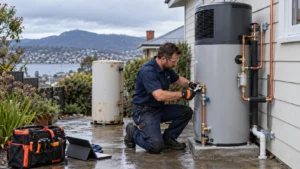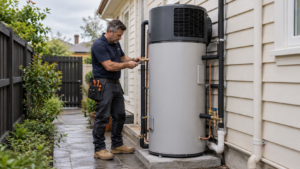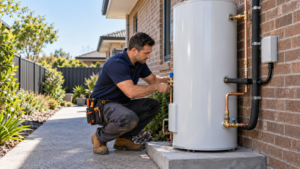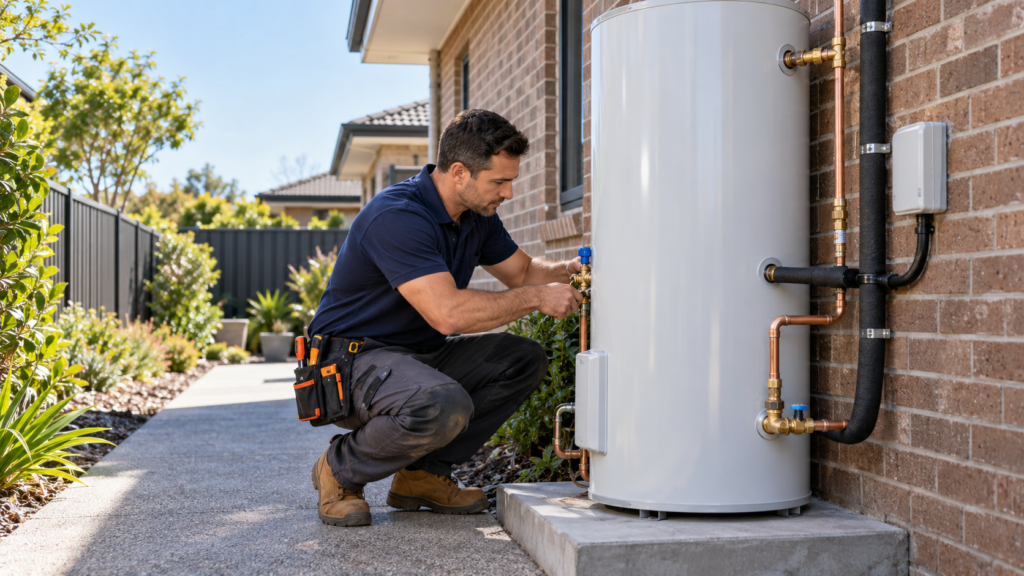
Replacing a hot water system in Sydney costs about $800 to $6,500 installed in 2026, depending on the type of system. A like-for-like electric storage tank swap is the cheapest at roughly $800 to $1,500. A gas storage tank runs $1,200 to $2,500, a gas continuous flow unit $1,500 to $3,500, and a heat pump $3,000 to $6,000 before rebates. Solar hot water sits at the top, from $3,000 to $6,500 installed.
Those figures cover the unit and the labour. NSW and federal incentives can take $900 to $1,350 off a heat pump and up to $1,200 off a solar system, which brings a typical heat pump installation down to around $3,900 out of pocket. At Solus Plumbing, our Sydney vans carry common replacement units so a failed tank can usually be swapped the same day, and every new installation comes with a 5-year workmanship warranty. In our experience, the biggest surprises on a replacement quote come from compliance work the old installation never had, which we cover below.
This guide breaks down 2026 Sydney prices by system type, the extra fees that get added to quotes, the rebates available in NSW, and how to size and choose a replacement without overspending.
Hot water system replacement prices in Sydney at a glance
| System type | Typical installed cost in Sydney (2026) | Approximate running cost per year |
| Electric storage tank | $800 to $1,500 | $700 to $900 |
| Gas storage tank | $1,200 to $2,500 | $350 to $550 |
| Gas continuous flow | $1,500 to $3,500 | $300 to $500 |
| Electric heat pump (before rebates) | $3,000 to $6,000 | $150 to $300 |
| Solar hot water (flat plate) | $3,000 to $5,500 | $80 to $250 |
| Solar hot water (evacuated tube) | $4,000 to $6,500 | $80 to $250 |
These ranges come from 2026 industry cost guides and include supply and installation, but not rebates. Sydney quotes tend to sit towards the upper end of national ranges because labour rates and compliance costs are higher in the city. An independent Sydney cost guide, for example, puts the typical quote for an electric storage replacement at about $1,700, with gas storage and continuous flow both around $2,100.
How much does it cost to replace an electric hot water system in Sydney?
Replacing an electric storage hot water system in Sydney costs about $800 to $1,500 installed for a standard 250 litre unit. Small 25 to 50 litre units can be as little as $500 to $800 installed, while large 250 to 315 litre tanks sit at the top of the range.
Electric storage is the cheapest system to buy and install because it needs no gas fitting and usually reuses the existing wiring and pipework. The trade-off is running cost. An electric tank on a standard tariff costs about $700 to $900 a year to run, which is the highest of any system type. Off-peak tariffs bring that down, which is why most Sydney homes with electric storage run a 250 litre or larger tank that heats overnight.
If your existing system is electric and you are replacing it, this is the point to check whether a heat pump makes more sense. The upfront cost is higher, but the NSW incentive for an electric-to-heat-pump swap is the most generous of all the rebates.
How much does a gas hot water system cost to replace in Sydney?
A gas storage hot water system costs about $1,200 to $2,500 installed in Sydney. A 4-star 170 to 250 litre tank usually lands between $1,200 and $1,800, with larger or premium models reaching $2,500 or more.
Gas continuous flow (also called instantaneous or tankless) costs about $1,500 to $3,500 installed. Small “builder” models suited to a one or two bathroom home start around $1,500, while high-output 15 to 20 litre per minute units and larger for big families reach $3,500 or more. Rinnai, Rheem and Bosch all make continuous flow units we install regularly.
Gas costs more to install than electric for three reasons:
- A licensed gas fitter is required. In NSW, gasfitting work needs a separate gasfitting licence on top of a plumbing licence.
- Gas line work. Swapping a storage tank for a continuous flow unit often needs a larger gas line, because continuous flow units draw more gas on demand.
- Compliance certificate. Gasfitting work in NSW must be certified, and the paperwork is part of the job.
Running costs are much lower than electric, at about $350 to $550 a year for storage and $300 to $500 for continuous flow. For a household with high hot water use and an existing gas connection, continuous flow is usually the cheapest system to run among the non-renewable options. Our gas fitting team handles the gas connection, pressure test and compliance certificate as part of the installation, so it does not appear as a separate trade on the quote.
How much does a heat pump hot water system cost in Sydney?
A heat pump hot water system costs about $3,000 to $6,000 installed in Sydney before rebates. After NSW and federal incentives, a typical mid-range installation nets out to roughly $3,900 if you are replacing an electric system, or about $4,050 if you are replacing gas.
Heat pumps are electric systems that pull heat from the surrounding air rather than heating water with an element directly. They use about a quarter to a third of the electricity of a standard electric tank, which is why running costs sit at only $150 to $300 a year. Sydney’s mild climate suits them well. Common brands include Rheem AmbiHeat, Sanden, iStore and Reclaim Energy.
A few things add to a heat pump quote that you will not see on a basic tank swap:
- Location. Heat pumps need airflow and make some noise from the compressor, so they cannot always go where the old tank sat. Moving the unit adds pipework and labour.
- Electrical work. Some units need a dedicated circuit, which means an electrician on site as well as a plumber.
- Base and drain lines. The NSW Government’s heat pump installation note lists common faults inspectors find, including missing pressure limiting valves, uninsulated pipework and tanks not set on a stable, level base. Doing this properly costs a little more, and it protects the warranty.
How much does solar hot water cost in Sydney?
Solar hot water costs about $3,000 to $5,500 installed for a flat plate system in Sydney, and $4,000 to $6,500 for an evacuated tube system. Both figures are before rebates, which can cut up to $1,200 off the price.
Solar systems are usually sized at 250 to 400 litres with an electric or gas booster for cloudy days. They have the highest upfront cost of any system but the lowest running costs, at about $80 to $250 a year. Evacuated tube collectors perform better in winter and on south-facing roofs, which is why they cost more.
Installation cost depends on roof access and whether the tank sits on the roof (close-coupled) or on the ground (split system). Two-storey homes and tiled roofs take longer, and a structural check may be needed for a roof-mounted tank full of water.
What extra fees get added to a hot water replacement quote?
Most Sydney hot water quotes include a few line items beyond the unit and the basic labour. The common ones are:
| Extra item | Typical Sydney cost | When it applies |
| Tempering valve | $200 to $300 | Required on most replacements where the old system did not have one |
| Old unit removal and disposal | $100 to $150 | Almost every replacement |
| Pressure limiting valve | Quoted per job | Where mains pressure is too high for the new tank |
| Relief drain line | Quoted per job | Where the old install had no compliant drain line |
| Electrical work | Quoted per job | Heat pumps on a new circuit, or rewiring old electric tanks |
| Gas line upgrade | Quoted per job | Storage-to-continuous-flow conversions |
The tempering valve catches most people out. Australian plumbing standards, which apply in NSW through AS/NZS 3500.4, limit hot water at bathroom taps and showers to 50 degrees Celsius to prevent scalding, while the tank itself must store water above 60 degrees to control Legionella bacteria. The Victorian Building Authority’s hot water safety guide explains both rules in plain terms. A tempering valve is what makes both possible. Many older Sydney installations were done before this rule, so the valve shows up as a new cost on the replacement.
When we quote a replacement at Solus Plumbing, we list these items separately so you can see what is the unit, what is labour, and what is compliance work. If a quote from any plumber is a single lump sum, ask for it to be broken down. Two quotes that look $400 apart are often quoting different jobs.
What hot water rebates are available in Sydney in 2026?
Sydney homeowners can claim two main rebates on an efficient hot water replacement in 2026: the NSW hot water upgrade incentive and federal Small-scale Technology Certificates (STCs). Together they are worth about $900 to $1,350 on a heat pump, and up to $1,200 on a solar system.
NSW hot water upgrade incentive
The NSW Government’s hot water upgrade incentive is delivered through the Energy Savings Scheme and applied as a discount on your quote by an accredited installer. In 2026, the incentive is worth up to $640 when you replace an electric storage system with a heat pump, and up to $330 when you replace a gas storage system. The heat pump needs a minimum five-year warranty and must be installed by an accredited provider.
Federal STC rebate
STCs apply to both heat pumps and solar hot water systems under the federal Small-scale Renewable Energy Scheme. The number of certificates depends on the system and your climate zone, and Sydney sits in Zone 3. For a 2026 heat pump installation, Solar Choice’s NSW heat pump rebate guide estimates the STC discount at about $490 to $680, with popular 270 to 315 litre units from iStore, Reclaim and Sanden landing between $570 and $640. The installer usually claims the certificates and shows the value as a discount on the invoice.
What that means for your quote
| Replacement scenario | Before rebates | NSW incentive | STC discount | Typical cost after rebates |
| Electric tank to heat pump | $4,700 to $5,200 | Up to $640 | $490 to $680 | About $3,900 |
| Gas tank to heat pump | $4,700 to $5,200 | Up to $330 | $490 to $680 | About $4,050 |
| Electric or gas to solar | $3,000 to $6,500 | Varies | Varies | Up to $1,200 off combined |
STC values fall each year as the scheme winds down towards 2030, so a heat pump installed in 2026 attracts a slightly larger discount than the same unit installed in 2027. Some Sydney councils add their own top-up, so it is worth checking your local council’s sustainability rebates before you book.
What size hot water system does a Sydney home need?
A typical person uses about 50 litres of hot water a day, so most Sydney households need a 125 to 315 litre storage tank or a 16 to 26 litre per minute continuous flow unit. Oversizing is one of the most common ways people overspend on a replacement.
As a rule of thumb:
- 1 to 2 people: about 50 to 80 litres of storage
- 3 to 4 people: about 80 to 250 litres, depending on tariff and system type
- 5 or more people: 250 litres or more, or a high-flow continuous flow unit
For a four-person household, Choice’s hot water buying guide suggests a 125 to 160 litre electric tank on a standard tariff (250 to 315 litres on off-peak), a 135 to 170 litre gas tank, or a 270 to 315 litre heat pump. Electric off-peak tanks need to be bigger because they heat once overnight and have to last the whole day. Continuous flow units are sized by flow rate rather than storage, so the question is how many showers and taps might run at once.
Choice also notes that water heating makes up about a quarter of a typical household’s energy use, so the running cost difference between systems adds up over the life of the unit.
What affects the cost of replacing a hot water system in Sydney?
Six factors explain most of the gap between two Sydney hot water quotes:
- System type and capacity. The unit is the biggest part of the price, and a 315 litre tank costs more than a 160 litre one.
- Like-for-like or a changeover. Swapping electric for electric is simple. Changing from electric to gas, or storage to continuous flow, adds gas, electrical or pipework changes.
- Compliance work. Tempering valves, pressure limiting valves and drain lines that the old installation did not have.
- Access and location. Tanks in roof spaces, tight subfloors, apartment plant rooms or up multiple flights of stairs take longer to remove and fit. Relocating a unit from indoors to outdoors adds pipework.
- Strata and apartments. Shared gas lines, body corporate approvals and limited outdoor space can restrict which systems you can install.
- Timing. A failed tank on a Sunday afternoon costs more to replace than one booked for a weekday. If the tank is only leaking slowly, turning off the water and cold feed and waiting until business hours can save several hundred dollars. Our guide to plumber costs in Sydney covers after-hours rates in detail.
Is it cheaper to repair or replace a hot water system?
Repairing a hot water system is usually cheaper if the unit is under 8 years old and the fault is a valve, thermostat, element or anode. Replacement is usually the better choice once the tank itself is leaking, or the system is 10 or more years old and needs a repair worth more than a third of a new unit.
A leaking tank cannot be repaired. Once the cylinder has corroded through, the only fix is a new system. For everything else, a general hot water repair in Sydney typically costs $170 to $575, with these common jobs inside that range:
- Thermostat, element or gas valve replacement: usually at the lower to middle end of the range
- Anode replacement: $230 to $575, and worth doing every five years on a mild steel tank to extend its life
- Tempering or relief valve replacement: $170 to $460
When we attend a hot water fault, we charge a $99 diagnostic fee on the first visit and credit it against the repair or replacement once you approve the price. That way you are not paying twice if the diagnosis shows the tank is beyond saving.
How do you check a hot water installer is licensed in NSW?
Every hot water replacement in NSW must be carried out by a licensed plumber, and gas systems also need a licensed gasfitter. You can check any tradesperson’s licence in about a minute using the Service NSW licence check tool.
Unlicensed work can void the manufacturer’s warranty on the new unit, cause problems with home insurance claims, and will not come with the compliance certificate your installer is required to provide. Ask for the licence number before the job starts, and make sure it covers gasfitting if a gas unit is involved. If you are claiming the NSW incentive, the installer also needs to be accredited under the Energy Savings Scheme, which is a separate check.
Frequently asked questions
How long does it take to replace a hot water system in Sydney?
A like-for-like hot water replacement usually takes 2 to 4 hours. Changeovers that need new gas lines, electrical circuits or a relocated unit can take most of a day. Most Sydney plumbers, including us, carry common replacement units on the van so a like-for-like swap can be done the same day you call.
Can I replace my hot water system myself in Sydney?
No. In NSW, installing or replacing a hot water system is licensed plumbing work, and gas units also need a licensed gasfitter. DIY installation is illegal, voids the unit’s warranty and can leave you without a compliance certificate for insurance purposes.
How much does it cost to switch from gas to a heat pump in Sydney?
Switching from gas storage to a heat pump in Sydney typically costs about $4,050 after rebates in 2026. The NSW incentive is smaller for a gas changeover (up to $330) than for an electric one (up to $640), but the STC discount of $490 to $680 applies to both.
Does a hot water replacement include removing the old unit?
Usually, but not always. Removal and disposal of the old tank is typically $100 to $150 and should be listed on the quote. If it is not mentioned, ask, because some installers leave the old unit on site for you to dispose of.
How long does a hot water system last?
Most storage tanks last around 10 to 15 years, and continuous flow units often last longer because there is no tank to corrode. Mild steel tanks usually carry a 5 to 10 year warranty and stainless steel tanks about 10 years. Replacing the sacrificial anode every five years can add several years to a mild steel tank’s life.
Get a fixed price for your hot water replacement in Sydney
Budget about $800 to $1,500 for a like-for-like electric tank swap, $1,200 to $3,500 for gas, and $3,000 to $6,500 for a heat pump or solar system before rebates. Then allow $300 to $500 for compliance items like a tempering valve and old unit disposal, and subtract $900 to $1,350 if you are moving to a heat pump. For any changeover rather than a direct swap, get at least two itemised quotes and check the installer’s licence before work starts.
If you want a written price before anything is touched, our hot water system team covers the Sydney CBD, Parramatta, Blacktown, Ryde, Liverpool, Penrith and surrounding suburbs 24 hours a day, seven days a week. We install Rheem, Rinnai, Dux, Bosch, Thermann and Vulcan units, repairs carry a 12-month workmanship warranty, and new installations come with a 5-year workmanship warranty on top of the manufacturer’s warranty. Call Solus Plumbing on 1300 730 896 or request a quote and we’ll give you the price before we start.